PLANNING CARE FOR PATIENTS WITH AN ARTIFICIAL ANUS
What is a colostomy? The placement of a colostomy has also become increasingly popular in recent times. According to statistics from the world organization, it shows that up to 1.3 million people are having to have a colostomy.
What is a colostomy
The placement of a colostomy has become increasingly common in recent times. According to statistics from the World Health Organization, there are up to 1.3 million people who have to have a colostomy.
A colostomy is primarily man-made. A colostomy (stoma) is created from an opening through the skin of the colon on the patient's left side with the purpose of draining waste to the outside, replacing the real anus. Stool will pass directly through this opening and empty into a waste collection bag (colostomy bag).
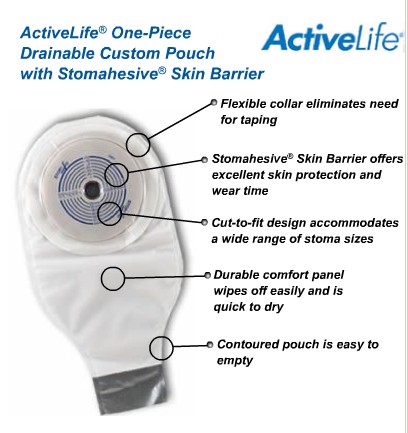
ActiveLife® 1-piece drainable colostomy bag
Who needs a colostomy?
People indicated for a colostomy are those who need to protect lower tract injuries, such as patients undergoing hemorrhoid surgery or patients who need to keep the sacral area clean to treat certain pathologies. People with late-stage rectal cancer who need to have it removed, ulcerative colitis causing heavy bleeding, etc.
How many types of colostomies are there
A temporary colostomy is only used for a certain period of time to help drain stool temporarily (about 3 - 6 months) due to illness or injury so that the lower bowel segment can rest and the bowel anastomosis site can heal. After that, the colostomy will be closed and normal bowel movement through the real anus will be restored.
A permanent colostomy is usually used in colorectal cancer, bringing the colon to the skin, and the patient will defecate through the colostomy for life.
Planning colostomy care
I. Purpose of colostomy care
- Clean the colostomy to help the patient be clean, comfortable, and recover early
- Keep the surgical site clean, avoid cross-infection from the colostomy
- Prevent sores around the colostomy
- Monitor and detect complications early: prolapse, retraction, displacement, or any abnormalities at the colostomy
- Advise and instruct patients on how to care for the colostomy at home upon discharge.
II. Preparation:
+ Explain the procedure to the patient, and instruct the patient to lie in a comfortable position.
+ Equipment
1. Irrigation solution (NaCl 0.9%)
2. Antiseptic solution (Betadine) (do not use iodine alcohol for patients with sores on the surrounding skin)
3. Cotton, gauze
4. Colostomy bag, measuring guide, scissors
5. Kidney basin
6. Underpad
7. Clean gloves
8. Hand sanitizer, instrument disinfectant solution
9. Various waste bags
III. Performing the technique:
1. Assessment:
- Which postoperative day is it? How many incisions are there? Status of drains and condition of incisions and drains.
- Status of the COLOSTOMY/ILEOSTOMY: which side is it on? Color of the mucosa, amount of stool output, condition of the surrounding skin...
2. Procedure:
- Explain and prepare a comfortable position for the patient.
- Place a pad under the COLOSTOMY/ILEOSTOMY area, expose it. Place a kidney basin.
- Perform hand hygiene, put on gloves, remove the old ostomy bag, assess the amount and characteristics of the stool.
- Put on new gloves, open the care tray, arrange the necessary instruments in the tray.
- Begin cleaning the COLOSTOMY/ILEOSTOMY stoma in a spiral motion outward to the mucosa and then to the surrounding skin, extending 5cm. Pat dry.
- Disinfect the surrounding skin, extending 5cm.
- Measure the bag and cut it according to the measured size. Clear away the kidney basin and pad.
- Apply the new ostomy bag. Smooth it to adhere closely to the skin surface. Check to ensure it is secure.
- Remove gloves and wash hands. Clean up instruments.
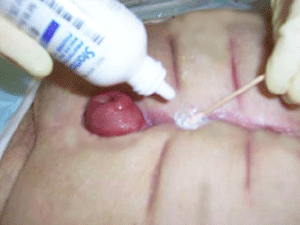
STOMAHESIVE® POWDER for peristomal skin protection
IV. DOCUMENTATION:
- Record the date and time of care. General condition of the patient.
- Record the status of the COLOSTOMY/ILEOSTOMY: color, characteristics (is it prolapsed, retracted, etc.?), color, amount & characteristics of stool...
- Clearly state the name of the nurse providing care.
V. Potential complications
- Prolapse/retraction of the COLOSTOMY/ILEOSTOMY
- Intestinal obstruction
- Parastomal hernia
- Peristomal abscess
- Digestive disorders: constipation, diarrhea...
VI. Diet for patients with a colostomy/ileostomy
- Limit foods that create odor and gas, causing foul-smelling stool (corn, dried beans, onions, cabbage, spicy foods, fish, antibiotics, some vitamins and minerals) and those high in fiber that increase stool volume.
Ways to reduce gas in the digestive tract include:
• Chew slowly, swallow with mouth closed.
• Drink water through a straw
• Do not eat gas-producing substances such as:
+ Lactose (in people with lactose intolerance)
+ Alcohol
+ Gas-producing products (such as apples, beer, cabbage, Brussels sprouts, watermelon, soybeans)
Combining with healthy fats, taking it in the morning, and waiting 1 - 2 hours after taking it before consuming caffeine or high-fiber meals... are ways to help make vitamin D supplementation more effective.