
Small care tips for quick and effective wound healing that you should not ignore
A good wound care process will help the wound heal quickly and limit unsightly scarring. So, what are the ways to take care of stitches to make them heal quickly? What are the notes you should not ignore to help the wound recover as quickly and effectively as possible? Please refer to the article below!
Quickly healing stitches - Things to do

Whether stitches heal quickly or not depends on many factors: constitution, suture location, age...
Change the dressing daily
- When do you need to change the dressing for the stitches?
Usually, at home, you should change the dressing at least once a day. However, in some cases, you will have to change the dressing more often, such as if the dressing is soaked with too much fluid, the dressing is dirty, or the dressing is unexpectedly splashed with dirty/damp water...
- Things to prepare before changing the dressing:
– Iodine alcohol
– Sterile gauze/bandage
– Physiological saline
– Adhesive tape/bandage roll
– Medical gloves
- Steps for changing dressings for stitched wounds at home:
Step 1: You need to wash your hands thoroughly with soap before changing the dressing. You can use medical gloves.
Step 2: Moisten the old wound dressing with physiological saline for 15 minutes.
Step 3: Gently peel the dressing off the wound.
Step 4: Clean off all fluid accumulated on the surface and black blood scabs sticking to the edges of the wound with damp gauze.
Step 5: Squeeze out the fluid accumulated inside the stitches (this is a very important step). You can perform the fluid squeezing using two techniques as follows: press the 2 edges of the wound and roll the gauze along the length of the stitches.
Step 6: Disinfect the wound again: dilute iodine alcohol with physiological saline at a ratio of 1:5, then use gauze soaked in the diluted alcohol solution to disinfect.
Step 7: The wound should be bandaged again with sterile gauze and fixed with a bandage roll or adhesive tape.
Aquacel Surgical - Hydrofiber technology dressing combined with waterproof Hydrocolloid adhesive bandage, used for clean surgical wounds with exudate. Dressing wear time up to 7 days.

Monitor and evaluate quick healing of stitches at home
- Normal signs
– Pain at the suture site: Usually, the patient will have the most pain in the first 3 days, after which the intensity of the pain will gradually subside. This pain sensation can be reduced by treatment with painkillers if used in the correct dosage and for the appropriate duration.
– Aching/swelling at the ends of the stitches: Having a wound will sever the veins under the skin. This will hinder the blood flow from the extremities back to the heart, causing circulatory stagnation. Depending on the degree of stagnation, phenomena such as swelling and aching (more or less) will be created. To overcome this situation, the patient needs to limit movement and elevate the extremity to make it easier for blood to move to the heart. For wounds on the forearm/hand, it is necessary to have a high arm sling worn around the neck. For wounds on the lower leg/foot, it is necessary to elevate the leg when resting and sleeping.
- Abnormal signs

Along with a reasonable rest and care regimen, it will make the stitches heal quickly
– Significant bleeding immediately after suturing
– Continuous pain for many days that gradually increases.
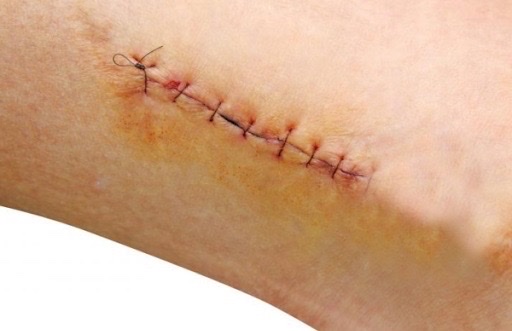
– The wound is swollen-hot-red
– The surrounding skin is edematous, tight/tense/swollen, with fluid accumulation under the suture line. The wound has increased discharge soaking through the bandage daily / oozing purulent discharge with a fishy odor
– The suture line has dehisced
– The patient has a high fever
When these signs appear, you need to quickly contact your doctor/go to the nearest medical facility to receive advice and timely treatment.
Personal hygiene
To help the suture heal quickly, avoid getting the sutured wound wet during the first 24 hours after surgery. On the first day post-surgery, you can wipe your body with a warm, wrung-out towel instead of bathing as usual.
From the second day onwards, limit physical activity, and if your body does not sweat excessively, you should limit bathing.
For the suture to heal quickly: if it is necessary to clean your body, you should take a quick shower and carefully cover the surgical area. Absolutely do not let dirty water or soap get on the suture.
Absolutely do not take a bath/soak in water/go swimming. When the wound is soaked in water, the epidermis tends to soften, causing the suture lines to open. This will create favorable conditions for resident skin bacteria and external bacteria to invade the wound.
Immediately after bathing, dry your body quickly, and gently wipe the skin around the wound with a clean towel.
For the suture to heal quickly - Things you absolutely should not do

A suture that heals quickly is a sign that the patient's health is stabilizing better
- Applying herbal leaves or sprinkling powder on the suture
When the fluid oozing from the wound mixes with the powder or leaves applied, it creates a very suitable environment for bacteria to grow. The effectiveness of sprinkling powder/applying herbal leaves has not been determined, but this action will certainly easily cause wound infection.
- Using betel leaf water / folk remedies to soak the suture
When your wound is soaked in water for a long time, the skin epidermis tends to soften, which will create a favorable environment for bacteria to invade. It is best to keep the wound dry at all times.
- Cleaning the wound with hydrogen peroxide multiple times
This is a mistake that many people have made. Because the nature of hydrogen peroxide is a substance with very strong antiseptic properties. Along with killing bacteria, it will also destroy even healthy cells. This solution is only used by doctors once during the initial cleaning for suturing. In the following days, if hydrogen peroxide is used again, it will destroy newly formed connective tissues, and the wound will take longer to heal. Using diluted iodine alcohol to clean the wound is the best option.
-ST-