
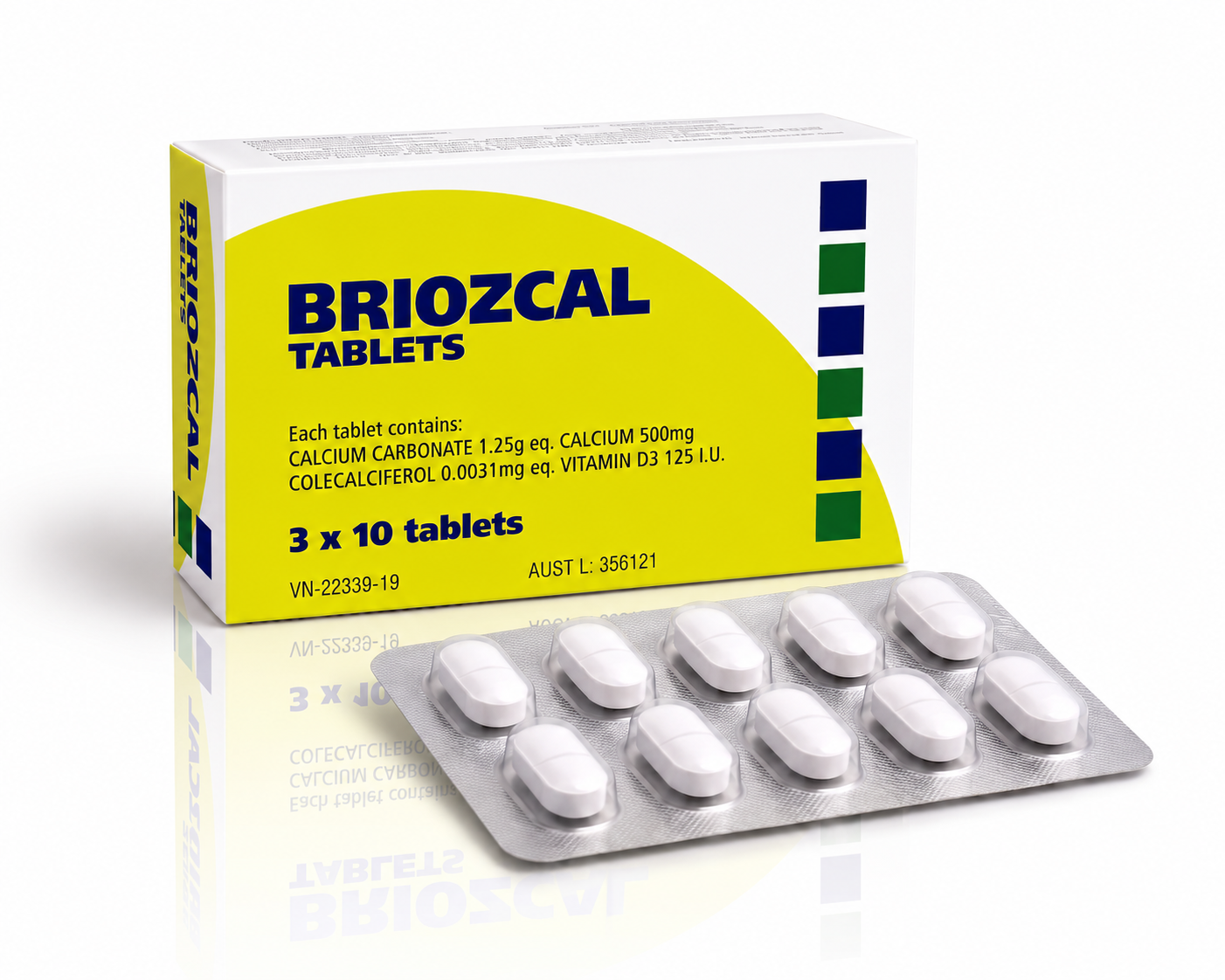
BRIOZCAL
Contains Calcium Carbonate and Vitamin D3 to strengthen bone and tissue.
Calcium carbonate and Vitamin D3 film-coated tablets for bone mineralisation support. Film-coated tablets supplying calcium carbonate and Vitamin D3 for bone strength and daily calcium supplementation.
Prescription-only medicine. Read the label before use. Ask your doctor or pharmacist if you need more information.
Composition
Active ingredients
Each film-coated tablet contains:
Calcium Carbonate 1.25 g (equivalent to 500 mg elemental calcium), Colecalciferol 0.0031 mg (equivalent to Vitamin D3 125 IU)
Excipients
Crospovidone, Carnauba wax, Magnesium stearate, Microcrystalline Cellulose, Hypromellose, Titanium dioxide, Macrogol 400, and Maize Starch.
Indications
- Prophylaxis and treatment of calcium/vitamin D3 deficiency; adjunctive treatment of osteoporosis in patients at risk of calcium/vitamin D deficiency.
- Adjunctive treatment of osteoporosis in women, the elderly, smokers, alcoholics, and other high-risk subjects such as: long-term corticosteroid use, after trauma, or long periods of immobilization.
- Treatment of rickets, osteomalacia, acute and chronic bone resorption.
- Daily calcium and vitamin D supplementation helps support the growth of the skeletal system and teeth in children, adolescents, and during puberty.
- Calcium supplementation for pregnant and lactating women to meet the increased calcium demand during this period, preventing complications due to acute and chronic calcium deficiency.
- Calcium supplementation for children, adults, and the elderly.
Dosage and Administration
Dosage should be reduced upon clinical and biochemical improvement or healing of bone disease.
Dietary Supplementation and Osteoporosis Prevention:
- Children under 18 years of age : Supplementation is not recommended for children under 18 years of age.
- Adults: Take 1-2 tablets daily with a glass of water, after meals or as directed by a physician.
Nutritional Rickets (Treatment):
- Use only as directed by a physician. Average dose: Take 2 tablets/day for about 10 days.
Use in other special populations: As directed by a physician.
- Patients with hepatic impairment, elderly: No dose adjustment is required.
- Patients with renal impairment, kidney stones: No dose adjustment is required, but calcium excretion should be monitored in patients with mild hypercalciuria, chronic renal failure, or a history of renal calculi formation.
Contraindications
- Hypersensitive to any ingredient of the drug.
- Vitamin D toxicity.
- Hypercalcemia, hypercalciuria, calcium stones.
- Cardiac and renal diseases (Severe renal impairment, severe kidney stones).
- Immobilization osteoporosis.
- Patients currently taking digitalis (due to the risk of digitalis toxicity).
In case of doubt, please consult a physician.
Warnings and Precautions
- Hypercalcemia may occur when renal function is impaired; serum calcium should be checked regularly. Calcium excretion should be monitored in patients with mild hypercalciuria, chronic renal failure, or kidney stones.
- Reduce dosage or discontinue medication if necessary. For further information, please consult a doctor or pharmacist.
- Caution is required in patients with Sarcoidosis or hypoparathyroidism (which may cause increased sensitivity to vitamin D); impaired renal function; heart disease; kidney stones; atherosclerosis.
Use in Pregnancy and Lactation
- Pregnancy: Recommended daily calcium allowance +400 mg, causes no harm when used at the recommended dose (1 tablet/day).
- However, pregnant women should receive calcium through an adequate diet. Excessive use of vitamins, calcium, and other minerals may cause harm to the mother or fetus.
- Lactation: Causes no harm when used at the normal daily requirement doses.
Effects on Ability to Drive and Use Machines
- The medicine has no influence on the ability to drive and use machines.
Interactions and Incompatibilities
- The following drugs inhibit renal calcium excretion: thiazides, clopamide, ciprofloxacin, chlortalidone, anticonvulsants
- Calcium reduces the absorption of demeclocycline, doxycycline, metacycline, minocycline, oxytetracycline, tetracycline, enoxacin, fleroxacin, levofloxacin, lomefloxacin, norfloxacin, ofloxacin, pefloxacin, iron, zinc, and other essential minerals
- Calcium increases the cardiac toxicity of digitalis glycosides because increased serum calcium concentrations enhance the inhibitory effect of cardiac glycosides on Na⁺ - K⁺ - ATPase
- Glucocorticoids and phenytoin decrease gastrointestinal calcium absorption. Diets containing phytates and oxalates reduce calcium absorption by forming poorly absorbable complexes
- Phosphate, Calcitonin, sodium sulfate, furosemide, magnesium, cholestyramine, estrogen, and certain anticonvulsants also decrease serum calcium levels
- Thiazide diuretics, on the other hand, increase serum calcium concentrations. The use of thiazide diuretics in patients with hypoparathyroidism may cause hypercalcemia, likely due to increased calcium release from bones
- Concomitant treatment of vitamin D with cholestyramine or colestipol hydrochloride is not recommended, as it may lead to decreased intestinal absorption of vitamin D.
- Excessive use of mineral oil may interfere with intestinal absorption of vitamin D.
- Concomitant treatment of vitamin D with thiazide diuretics in patients with hypoparathyroidism may lead to hypercalcemia. In such cases, the dosage of vitamin D should be reduced or temporarily discontinued
- Vitamin D should not be co-administered with phenobarbital and/or phenytoin (and possibly other hepatic enzyme-inducing drugs), as these agents may decrease plasma concentrations of 25-hydroxyergocalciferol and 25-hydroxy-colecalciferol and increase the metabolism of vitamin D to inactive metabolites
- Vitamin D should not be co-administered with corticosteroids, as corticosteroids interfere with the action of vitamin D
- Vitamin D should not be co-administered with cardiac glycosides, as the toxicity of cardiac glycosides increases due to hypercalcemia, leading to cardiac arrhythmias
Undesirable Effects
Reduce dosage or discontinue medication if necessary
- The product contains vitamin D3 125 IU/tablet. Taking vitamin D at doses not exceeding physiological requirements is usually non-toxic. However, hypervitaminosis D may occur with high-dose or prolonged treatment, or with increased response to normal doses of vitamin D, leading to clinical manifestations of calcium metabolic disorders.
- In adults, hypervitaminosis D may result from vitamin D overdose in cases of hypoparathyroidism or excessive self-administration of extremely high doses of vitamin D.
- Some infants may show increased sensitivity to small amounts of vitamin D. Toxicity can also occur in children after accidentally ingesting adult doses of vitamin D.
- Initial signs and symptoms of vitamin D toxicity are those of hypercalcemia (see below). Hypercalcemia in hypervitaminosis D is due solely to very high circulating 25-OHD levels, whereas plasma PTH and calcitriol levels are both decreased.
The frequency of adverse drug reactions is defined as follows:
Common: (> 1/100)
Uncommon ( >1/1,000 to - Metabolism disorders: uncommon (hypercalcemia, hypercalciuria).
- Renal and urinary disorders: Decreased libido, nephrocalcinosis, impaired renal function (leading to polyuria, nocturia, polydipsia, low urine specific gravity, proteinuria).
- Others: Rhinorrhea, pruritus, osteoporosis in adults, growth retardation in children, weight loss, anemia, calcific conjunctivitis, photophobia, metastatic calcification, pancreatitis, generalized vascular calcification, convulsions.
Rare ( > 1/10,000 to - Gastrointestinal disorders: Rare (constipation, flatulence, nausea, abdominal pain, and diarrhea).
- Cardiac disorders: Hypertension, cardiac arrhythmias.
- Metabolism disorders: May increase hypercalciuria, hyperphosphaturia, albuminuria, blood urea nitrogen, serum cholesterol, AST (SGOT) and ALT (SGPT) levels. Decreased serum alkaline phosphatase levels.
- Others: Overt psychosis, serum electrolyte imbalance along with mild acidosis.
Very Rare ( Management of ADRs:
- Because hypercalcemia can be more dangerous than hypocalcemia, vitamin D overdose should be avoided in the treatment of hypocalcemia.
- Serum calcium levels should be determined frequently and maintained at 9 - 10 mg/dL (4.5 - 5 mEq/L). Serum calcium concentration generally should not exceed 11 mg/dL.
- During vitamin D therapy, periodic determination of serum calcium, phosphate, magnesium, blood urea nitrogen, blood alkaline phosphatase, and 24-hour urinary calcium and phosphate should be performed.
- A decrease in serum alkaline phosphatase concentration usually precedes hypercalcemia in patients with osteomalacia or renal osteodystrophy.
Overdose and Management
- When serum calcium levels exceed 2.9 mmol/L (12 mg/100 mL), the following measures must be taken immediately: Fluid resuscitation with intravenous 0.9% sodium chloride infusion. Diuretics may be used to increase calcium excretion; however, thiazide diuretics must not be used as they increase renal tubular reabsorption of calcium. Monitor blood potassium and magnesium levels and replace them early to prevent treatment complications. Monitor electrocardiogram (ECG) and beta-adrenergic blockers may be used to prevent severe cardiac arrhythmias. Hemodialysis, Calcitonin, and adrenocorticoids may be used in treatment. Regularly measure serum calcium levels at defined time intervals to guide clinical management.
- Additionally, agents such as Calcitonin, bisphosphonates, and plicamycin may be used if the above measures are ineffective.
- In case of a missed dose: Take the prescribed dose as soon as remembered and continue with the normal dosing schedule. Do not take a double dose to make up for a missed dose.
Pharmacodynamic Properties
Calcium and vitamin D are essential elements in bone formation. Vitamin D assists in calcium absorption. Calcium: Oral form is used to treat deficiency and hypocalcemia. Calcium supplementation is also part of prevention to reduce the body's risk of osteoporosis.
Calcium deficiency occurs when the daily diet does not supply adequate calcium, frequently occurring in the elderly, as well as pre- and postmenopausal women.
Hypocalcemia occurs in cases of: chronic hypoparathyroidism, pseudohypoparathyroidism, osteomalacia, rickets, chronic renal failure, anticonvulsant therapy, or vitamin D deficiency.
Vitamin D3 (International Nonproprietary Name: colecalciferol) is one of the compounds in the vitamin D group, consisting of sterol compounds with similar structures that possess activity in preventing and treating rickets.
Vitamin D3, together with parathyroid hormone and calcitonin, regulates serum calcium concentrations. The principal function of vitamin D is to maintain normal plasma calcium and phosphorus concentrations by enhancing the efficiency of intestinal absorption of these minerals from the diet and increasing the mobilization of calcium and phosphorus from bone into the bloodstream.
Vitamin D deficiency occurs with inadequate sunlight exposure, dietary deficiency of vitamin D, or in individuals with fat malabsorption syndromes, including those with gastrointestinal disorders. Certain conditions in patients with renal failure may also affect the metabolism of vitamin D to its active form, leading to vitamin D deficiency.
Renal osteodystrophy is commonly associated with chronic renal failure and is characterized by decreased conversion of 25-OHD3 to 1α, 25-(OH)2D3 (Calcitriol). Phosphate retention causes decreased plasma calcium levels, leading to secondary hyperparathyroidism pathogenetically, featuring characteristic lesions of hyperparathyroidism (osteitis fibrosa), vitamin D deficiency (osteomalacia), or a combination of both. Vitamin D deficiency leads to symptoms characterized by hypocalcemia, hypophosphatemia, inadequate mineralization or demineralization of bone, bone pain, and fractures—termed osteomalacia in adults; in children, it can lead to bone deformities, particularly of the long bones, termed rickets.
Vitamin D-dependent rickets is an autosomal recessive genetic disorder involving an inborn error of vitamin D metabolism associated with decreased conversion of 25-OHD3 to Calcitriol.
Pharmacokinetic Properties
Intestinal calcium absorption is inversely proportional to dietary calcium intake; therefore, a low-calcium diet leads to compensatory increased absorption, mediated in part by the action of vitamin D.
After oral administration, calcium carbonate is converted into calcium chloride by gastric acid. Approximately 30% is absorbed in the small intestine via the gastrointestinal tract. 99% of total body calcium is concentrated in the structure of bones and teeth. The remaining 1% is distributed in intracellular and extracellular fluids. About 50% of total blood calcium is in the physiologically active ionized form, approximately 10% is complexed with citrate, phosphate, or other anions, and the remaining 40% is bound to proteins, primarily albumin.
Following administration, urinary calcium ion excretion is the difference between the amount filtered at the glomerulus and the amount reabsorbed. Renal tubular reabsorption is highly efficient, as more than 98% of calcium ions filtered through the glomerulus are reabsorbed into the bloodstream. Reabsorption efficiency is primarily regulated by parathyroid hormone and is also influenced by Na+ clearance, the presence of non-reabsorbed anions, and diuretics. Diuretics acting on the ascending limb of the loop of Henle increase calciuria. Conversely, thiazide diuretics are unique in that they do not couple Na+ and Ca2+ excretion, thereby reducing calciuria. Parathyroid hormone constantly regulates serum calcium ion concentrations by acting on the renal tubules. Urinary calcium is only minimally affected by dietary calcium in healthy individuals.
Calcium is excreted in feces, urine, and sweat. Renal excretion depends on glomerular filtration and tubular reabsorption of calcium. Reabsorption efficiency is influenced by parathyroid hormone, Na+, and diuretics.
During lactation, a portion of calcium is excreted into breast milk.
Vitamin D
Absorption: Vitamin D3 is absorbed in the small intestine. Bile is essential for intestinal absorption of vitamin D. Because vitamin D is lipid-soluble, it is incorporated into chylomicrons and absorbed via the lymphatic system. Colecalciferol and its metabolites circulate in the blood bound to a specific globulin. Colecalciferol is converted in the liver by hydroxylation to the active form 25-hydroxycolecalciferol. In fact, 25-hydroxycolecalciferol has a higher affinity for protein than the parent compound. It is subsequently converted in the kidneys to 1,25-dihydroxycolecalciferol. 1,25-dihydroxycolecalciferol is the metabolite responsible for enhancing calcium absorption. Unmetabolized vitamin D is stored in adipose and muscle tissues.
The elimination half-life of vitamin D is 19 – 25 hours.
Vitamin D and its metabolites are excreted mainly via bile and feces, with only small amounts appearing in urine. Some forms of vitamin D may be excreted into milk.
Packaging - Storage Conditions
Storage conditions: below 30⁰C. Protect from direct sunlight. Keep out of reach of children.
Do not use the medicine beyond the expiry date stated on the packaging or if the blister strip is torn or damaged.
Shelf life : 36 months from the manufacturing date.
Specification : Manufacturer's standard